For decades, milk has been considered a symbol of a healthy diet. Its high calcium content, high-quality protein, and vitamins have made it often deemed essential, especially in strength training. However, in recent years, the view of milk has become increasingly critical. Allegations such as:
- “Milk makes you fat”
- “Milk hinders definition”
- “Milk increases insulin and prevents fat loss”
- “Milk causes inflammation”
How much truth is there in these claims?
The Key Factor is not Milk – but Calorie Balance
The key factor for a lean body is and remains the energy balance.
A body is defined when a calorie deficit is sustained over a longer period. No single food – including milk – causes an increase in body fat as long as total calorie intake is controlled.
Scientific studies clearly demonstrate:
Weight gain occurs from a long-term calorie surplus – not from the consumption of a specific food.
A comprehensive meta-analysis in the American Journal of Clinical Nutrition showed that dairy products are neither significantly associated with increased fat mass nor obesity, provided total energy intake is considered.
Thus, milk is not an “automatic fattening agent.”
Milk and Muscle Building – an Underestimated Advantage
Milk contains two high-quality types of protein:
- Whey protein – quickly available, promotes muscle protein synthesis
- Casein – slow-digesting, acts anti-catabolic
Studies by Wilkinson et al. (2007) and Hartman et al. (2007) showed that low-fat milk can effectively stimulate muscle protein synthesis post-training – comparable to isolated protein shakes in some cases.
This means:
Milk can even actively contribute to achieving a defined physique, as muscle mass increases basal metabolism and improves body composition.
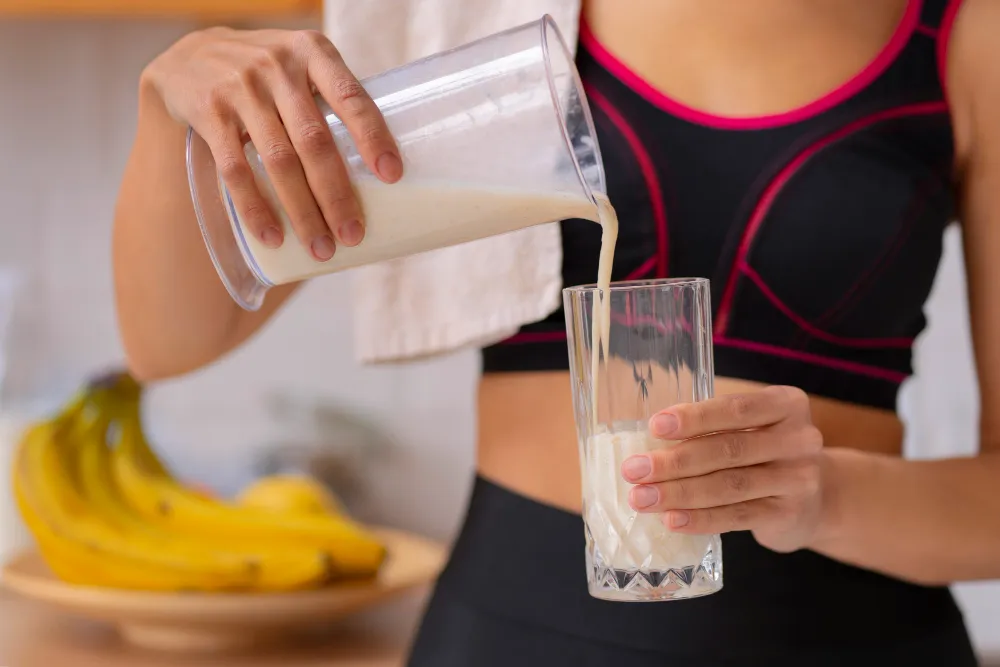
Milk and Insulin – A Problem?
Milk generates a moderate insulin response. This is often cited as an argument against milk consumption when aiming for fat loss.
However, what is important to note is:
Insulin is not a “fat hormone” but primarily a storage and transport hormone.
Short-term insulin spikes after protein-rich meals do not automatically inhibit fat loss.
Studies show that protein-induced insulin spikes behave metabolically differently than high sugar loads.
As long as there is a calorie deficit, body fat will be reduced – regardless of milk consumption.

Milk and Body Fat – What Do Studies Say?
Several systematic reviews indicate:
- No significant link between moderate milk consumption and increased fat mass
- Sometimes even better body composition with higher protein intake
- Low-fat dairy products can be supportive in diets
A meta-analysis in the International Journal of Obesity concluded that dairy products can even support fat loss in calorie-restricted diets.
Nutritional Comparison of Different Types of Milk
| Type of Milk | Calories (per 100 ml) | Protein | Fat | Suitable for Diet? |
|---|---|---|---|---|
| Whole milk (3.5%) | approx. 64 kcal | 3.3 g | 3.5 g | In moderation |
| Low-fat milk (1.5%) | approx. 47 kcal | 3.4 g | 1.5 g | Very good |
| Skim milk (0.1%) | approx. 34 kcal | 3.4 g | 0.1 g | Optimal for definition |
| Protein milk | approx. 50–60 kcal | 5–10 g | variable | Very good |
| Plant-based drinks (oat) | 40–60 kcal | usually <1 g | variable | No equivalent protein substitute |
Especially skim or low-fat variants provide high-quality protein with relatively low energy density – ideal for a definition phase.
Does Milk Make You “Soft” or Promote Water Retention?
A common myth suggests that milk leads to a “soft look” or subcutaneous water retention.
There is no solid scientific evidence for this claim in healthy individuals without lactose intolerance.
Problems may arise with:
- Lactose intolerance
- individual intolerances
- highly processed dairy products with added sugars
Pure milk does not cause visibly definitional water retention in healthy people.

Is Milk Overrated?
Milk is not a “wonder drug” – nor is it a problematic food.
It offers:
- High-quality protein
- Calcium for bone health
- Vitamin B12
- A convenient and affordable protein source
However, it is not essential. Those who do not like it or tolerate it can easily meet their protein needs through other sources.
It is only overrated if one believes it is solely crucial for muscle building or health.
When Can Milk Be Problematic?
Milk may be less ideal for those with:
- Lactose intolerance
- Prone to acne (some studies show slight correlations)
- very high consumption during mass phases with a calorie surplus
The issue in these cases does not lie with milk itself – but with the quantity or individual reaction.
Conclusion – Does Milk Prevent a Lean Body?
No.
Milk does not prevent a lean body.
The deciding factors are:
- Calorie balance
- Total protein intake
- The training stimulus
- Sleep and recovery
- Lifestyle
Low-fat or skim milk can even be a sensible food in a definition phase, as it provides high-quality protein at a relatively low energy density.
Milk is neither a miracle food nor a fattener. It is a neutral food whose effect, as with all foods, depends on context, quantity, and individual tolerance.
A lean body is built through structure, discipline, and calorie control – not by eliminating a single beverage.