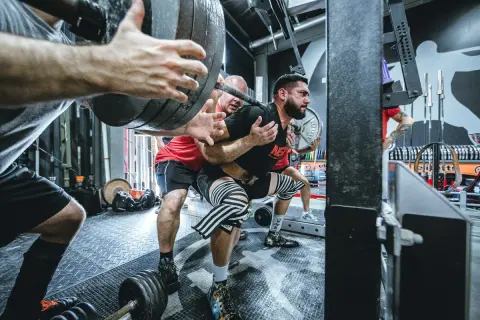
You wake up in the morning, want to get out of bed – and then it hits you: muscle soreness. Every step hurts, the stairs become the ultimate challenge, and yet the question creeps in:
Should I train today or take a break?
The fitness world is divided. Some say: “No pain, no gain”, while others warn against overexertion and injuries. But what does science say? And more importantly: What is truly beneficial for your body?

What Muscle Soreness Really Is – and What It Isn’t
Muscle soreness is not a sign of “lactic acid in the muscle,” as was often claimed in the past. Today we know:
Muscle soreness is caused by microscopic tears in muscle fibers, especially after unfamiliar or eccentric loads (e.g., slow lowering during squats or bench presses).
These micro-injuries lead to:
- Inflammatory reactions
- Water retention in the muscle
- Sensitivity and stiffness
Important: Muscle soreness is not damage – but a part of the adaptation process. This is where the actual discussion begins.

Training with Muscle Soreness – Is That Even Possible?
The honest answer is: Yes – but not always, and not immediately.
There are two types of muscle soreness you should distinguish:
| Type of Muscle Soreness | Feeling | Is Training Reasonable? |
|---|---|---|
| Mild Muscle Soreness | Tension, slightly painful | Yes, with adjustments |
| Severe Muscle Soreness | Painful, restricted movement | No |
Mild muscle soreness indicates that your body has already begun repairs. Adjusted training can even promote blood circulation and accelerate recovery.
Severe muscle soreness, on the other hand, is a clear signal:
👉 Your muscle is not yet resilient.

Why Hard Training Despite Severe Muscle Soreness Is Counterproductive
If you dive into full training with severe muscle soreness, you risk:
- Extended recovery time
- Poorer technique due to pain avoidance
- Increased risk of injury (tendons, joints)
- Lesser muscle growth
Muscle growth happens not in training, but in the recovery afterward. Those who constantly disrupt this process remain stagnant in the long run.

When Training with Muscle Soreness Can Actually Be Beneficial
There are situations where movement, despite muscle soreness, is helpful:
- Active recovery (e.g., light cardio, mobility)
- Training other muscle groups
- Very light technical or volume training
- Stretching combined with circulation
A classic example:
Legs have muscle soreness → upper body training is no problem.
Or:
Mild muscle soreness → reduced weight, higher repetitions, focus on technique.

The Biggest Misconception: Muscle Soreness = Effective Training
Many believe a good workout must cause muscle soreness. This is a myth.
Muscle soreness means:
- New stimulus
- Unfamiliar strain
It does not automatically mean:
- More muscle growth
- Better training plan
- Higher efficiency
Advanced athletes often have less muscle soreness because their body is better adapted to stress – and still build muscles.

How to Make the Right Decision on Muscle Soreness Days
Ask yourself these questions before training:
- Can I move the muscle painlessly?
- Is my mobility significantly restricted?
- Am I experiencing strength loss?
- Does the movement feel “off”?
If you answer more than one question with Yes → pause or opt for alternative training.

Practical Tips for Training Days with Muscle Soreness
- Reduce intensity (50–70%)
- Focus on technique rather than weight
- Extend warm-up
- Reduce eccentric load
- Listen to your body – not your ego
Intelligent training leads to more long-term results than any forced workout.

Conclusion: Training with Muscle Soreness – Smart Instead of Stubborn
Muscle soreness is not an enemy but a feedback mechanism of your body.
Mild muscle soreness can be accompanied by adjusted training.
Severe muscle soreness requires respect, patience, and recovery.
If you want progress, you must understand:
Not every training day is an assault – some are maintenance work.
Do not train against your body, but with it.