What is 1RM (One-Rep Max) and How to Calculate It?
Are you looking to make your workout program more effective and maximize your performance? Then you should get familiar with the concept of 1RM, or One-Rep Max. 1RM represents the…
Read articleTraining

You wish to build muscles. More volume, more definition, more "Wow" in the mirror.
And then arises the question that pops up in every gym, under every YouTube video, and in every forum:
Should I train in the hypertrophy range or rather engage in heavy strength training?
In short: Both methods lead to muscle growth - but not in the same way and not to the same extent.
Let's approach the subject honestly, practically, and scientifically grounded.

Hypertrophy essentially means muscle enlargement. The muscle thickens because the muscle fibers adapt and build more structures.
Typical characteristics of hypertrophy training include:
Here, it's less about how much weight you lift and more about how long and intensely the muscle is working.
You can compare it to:
Strength training = maximum pressure on a point
Hypertrophy training = sustained stress on the entire area
Both are effective - but in different ways.

Traditional strength training often uses:
The goal is clear: to become stronger.
The nervous system learns to activate more muscle fibers simultaneously.
And yes: Even with strength training you build muscles.
But it is often not optimal if your main goal is purely visual muscle growth.
Why?
Because the muscle is indeed challenged extremely, however:
It's like shouting at a muscle briefly instead of putting it under pressure for a long time.

Studies show quite clearly:
Muscle growth is possible across a wide range of repetitions
Crucial are sufficient training volume, training close to muscle failure, and progressive overload.
Interestingly:
Research (e.g., Schoenfeld et al.) indicates that hypertrophy training and strength training can yield similar muscle gains when the volume is equal –
however:
👉 Hypertrophy training is more efficient when it comes to targeted muscle growth.
👉 Strength training is superior if maximizing strength is the primary goal.
In brief:

Hypertrophy training:
Especially in the long run – and this is crucial – you can train more consistently without constantly pushing the limits of tendons, ligaments, and the nervous system.
Many trainees fail not because of the training itself, but because they train too heavy, too often, too ego-driven.

Now comes the twist 😏
Strength training is not the enemy of muscle building – quite the opposite.
More strength means:
A stronger muscle can move more weight with 8–12 repetitions – and this is precisely what promotes hypertrophy.
That's why pure pump training without increasing strength is often a dead-end.

The human muscle doesn't distinguish between "hypertrophy day" and "strength day".
It responds to:
The best programs combine:
Or in other words:
Heavy weights create the stimulus – volume makes the muscle big.

If your goal is maximum muscle growth, then hypertrophy training is the foundation.
Strength training is not a replacement – rather a tool to become stronger and support this muscle growth in the long term.
The smartest strategy is:
Muscles do not grow through extremism – but through intelligent balance.
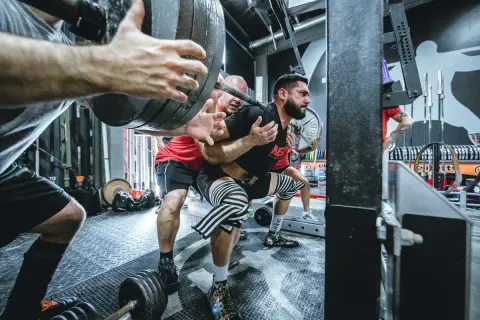
Are you looking to make your workout program more effective and maximize your performance? Then you should get familiar with the concept of 1RM, or One-Rep Max. 1RM represents the…
Read article
This blog provides a detailed analysis of the Heavy Duty training approach, including training plans, scientific studies, advantages and disadvantages, as well as concrete…
Read article
Sport is the cornerstone of a healthy lifestyle, signaling a fresh start for many. This blog post offers beginners step-by-step guidance, motivation sources, and success tips for…
Read article