
Anyone currently engaging with endurance training, fitness, or longevity will likely encounter a term frequently mentioned: Zone 2.
On social media, in gyms, during running sessions, and via smartwatches, there's an increasing recommendation to deliberately perform a significant portion of training at a slow pace. Rather than making every workout as fast and intense as possible, one should, for example, jog lightly, cycle, or train on a treadmill, ensuring that the exertion level remains manageable.
Initially, this might sound almost contradictory. After all, many people associate a “good” workout with strong sweating, a high heart rate, and the feeling of complete exhaustion.
However, this is precisely where Zone-2 training comes in: Not every workout needs to be maximally strenuous to be effective.
Nevertheless, the current enthusiasm for Zone 2 is scientifically more complex than some social media posts may suggest. For instance, a 2025 systematic review concludes that Zone 2 is not necessarily the “best” intensity for the general population.

What does Zone 2 actually mean?
The term “Zone 2” describes a low to moderate training intensity within a heart rate or exertion model.
The problem: There isn’t one universal definition of Zone 2.
Depending on the training system, sport, and method used, the boundaries may differ. This is also highlighted in an expert work from 2025: Among sports scientists and coaches, there’s still no full consensus on how exactly Zone 2 should be defined.
Simply put, it is an intensity where you work noticeably but still train relatively controlled.
A typical example:
You are running or cycling. Your breathing is faster than at rest, yet you’re not out of breath. You could still have a conversation with someone, although you might not want to give a long speech.
The well-known “Talk Test” principle can thus serve as a practical guide.

Why is slow training even interesting?
The body doesn’t always operate in the same way at different exertion intensities.
At low to moderate exertion, the body can derive a relatively large share of its energy from aerobic metabolism. Here, mitochondria play a central role.
Mitochondria are often called the “powerhouses” of cells. They help provide energy from nutrients using oxygen.
Endurance training can promote adaptations in the cardiovascular system and muscles. Precisely for this reason, regular aerobic training is vital to physical fitness.
However, an important distinction is necessary here:
Zone 2 is not synonymous with “fat burning = automatically better.”
Online, Zone 2 is often portrayed as a magical “fat burning zone.” In reality, the energy provision during training is much more complex. Moreover, it’s not solely about how many fat calories are burned during a session that determines if someone will lose body fat long-term.

What happens at different training intensities?
Our energy system adapts to the exertion.
At low intensity, the body can supply energy aerobically for longer periods. As the exertion becomes significantly higher, the need for rapid energy provision increases.
As intensity rises, so does heart rate, oxygen consumption, and lactate production.
Lactate is not just a “waste product” as it was often simplistically portrayed. It can be reused and serve as an energy carrier.
Thus, it is scientifically more meaningful to view Zone 2 as part of a comprehensive exertion and training system rather than a magical zone where entirely different physiological processes suddenly occur.

How do I recognize my Zone 2?
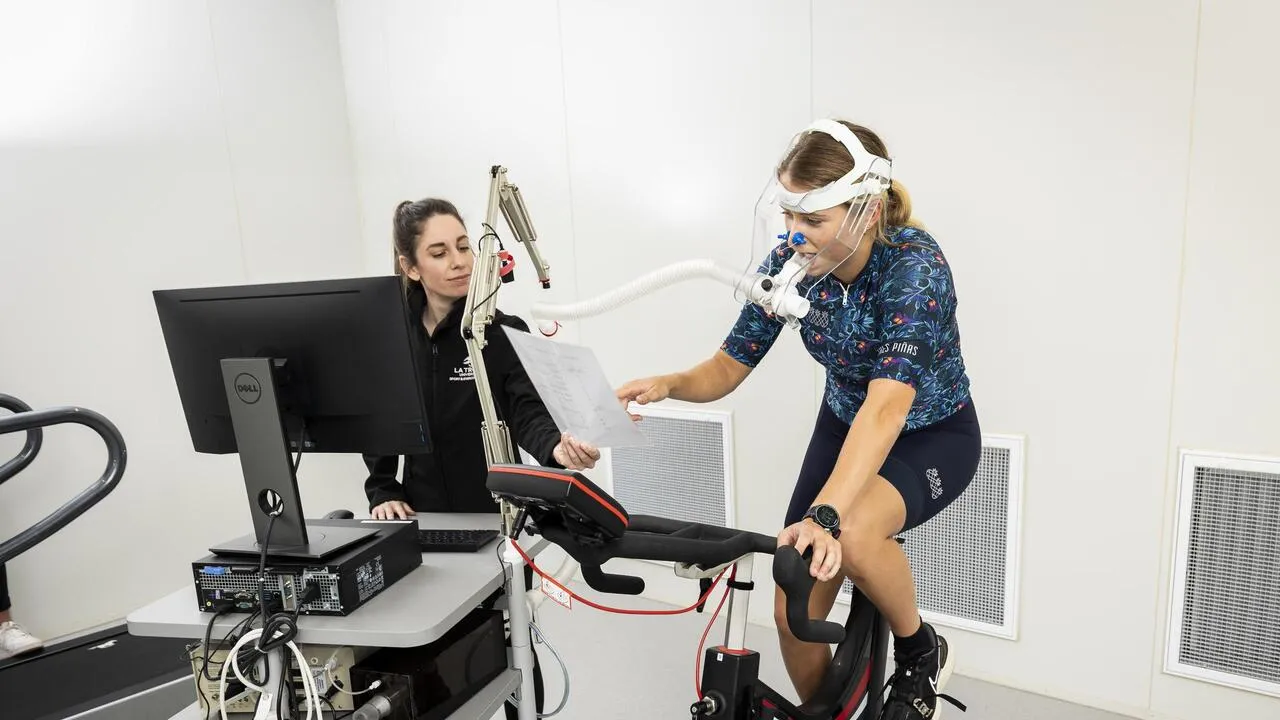
An exact determination can be achieved through performance diagnostics, including breath gas and/or lactate measurement.
For recreational athletes, this is generally not necessary.
Several simple cues are more practical:
| Method | What it indicates | Accuracy |
|---|---|---|
| Conversation Test | Speaking is still easily possible | Simple |
| Subjective Exertion | Training feels controlled | Simple |
| Heart Rate | Exertion estimated via pulse | Medium |
| Lactate Measurement | Metabolic response is directly examined | High |
| Spirometry | Oxygen uptake and breathing gases are analyzed | Very high |
It is crucial to note: A specific heart rate figure does not automatically apply to everyone.
Age, training status, medications, sleep, stress, temperature, and even caffeine can influence heart rate.
Thus, a smartwatch should not be regarded as an absolute truth.

Why do endurance athletes often train slowly?
Here it gets particularly interesting.
Elite endurance athletes spend a significant part of their training at low intensity. However, this does not mean they train slowly exclusively.
On the contrary, high-intensity sessions are also part of the training.
The concept behind it is rather a distribution of different training intensities.
A substantial amount of relatively easy sessions can allow for overall high training volume without constantly subjecting the body to very high exertions.
Targeted intense training sessions can be interspersed in between.
A large network meta-analysis from 2025 examined various training intensity distributions among endurance athletes, showing that different strategies can induce different adaptations.
This is an important point:
Effective endurance training does not automatically mean: always slow.
Instead, it means employing the right intensity for the individual training goal.

Zone 2 and the Mitochondria
One of the main reasons for the current Zone 2 hype is mitochondria.
Endurance training can enhance the muscles' ability to provide energy aerobically. Adaptations of mitochondrial capacity play a significant role here.
However, one should be cautious about making grand promises.
A 2025 review titled Much Ado About Zone 2 examined claims that Zone 2 is the optimal intensity for improving mitochondrial performance and fat oxidation.
The result was much more restrained than many social media promises: Current evidence does not support the claim that Zone 2 is inherently the optimal intensity for these adaptations. Especially for those with limited time, higher intensities can also be very relevant for certain cardiometabolic adaptations.
Zone 2 can therefore be beneficial – but it is not a biological secret trick.
Is Zone 2 better than HIIT?
The short answer is:
No.
But also:
HIIT isn’t automatically better.
Both forms of training have their strengths.
For example, an intense interval training session can provide strong stimuli in a relatively short time. This can be attractive for people with limited time.
Conversely, Zone-2 training allows for longer exertions with less perceived effort and can be well integrated into larger training volumes.
A recent systematic review compared high-intensity interval training with moderate continuous training among endurance runners, revealing different effects on various performance parameters – another indication that training effects are strongly dependent on the specific goal.
The better question is therefore not:
“Zone 2 or HIIT?”
But rather:
“Which combination fits my goal, my training status, and my available time?”

Why Zone 2 is attractive to many people
A major advantage lies in its suitability for everyday life.
An easy run, a bike ride, or a session on the ergometer can be physically demanding without leaving you completely exhausted afterward.
This can be particularly appealing for people who want to train regularly.
For example, someone who trains four times a week and does each session to the maximum intensity may quickly find that recovery, motivation, and everyday life suffer as a result.
Consciously making part of the sessions easier can therefore help integrate more movement sustainably into daily life.
And that is health-wise decisive.
The World Health Organization recommends at least 150 to 300 minutes of moderate aerobic activity per week for adults, or alternatively 75 to 150 minutes of intense activity, or a corresponding combination. Additionally, muscle-strengthening activities on at least two days a week are recommended.
The main message is therefore not “Always train in Zone 2,” but rather:
Move regularly and find an intensity you can maintain long-term.

Can you lose weight with Zone 2?
Yes, regular Zone-2 training can be part of a weight regulation strategy.
However, here too the term “fat burning zone” is often misunderstood.
During a light exertion, the energy derived from fats can be relatively high. Yet, this does not automatically mean you will lose more body fat than with more intense training.
For long-term weight loss, factors such as overall energy balance, diet, activity level, muscle mass, and long-term training routine are crucial.
Zone 2 can help increase overall energy expenditure while providing a form of exercise that many people can regularly engage in.

Zone 2 in everyday life: How it can look
You don’t have to be a marathon runner for this.
A simple example could look like this:
Monday: 30–45 minutes of easy cycling
Tuesday: Strength training
Wednesday: 30–45 minutes of easy jogging or brisk walking
Thursday: Rest or light activity
Friday: Strength training
Saturday: Longer, easy endurance session
Sunday: Walk or rest
This is, of course, just an example.
For beginners, the duration might be significantly shorter. Those who are already very fit can train for longer accordingly.
The key is progressive improvement, not chasing a specific heart rate number.

Do you really have to run slowly during Zone 2 training?
Not necessarily.
Zone 2 is a load intensity, not a specific speed.
For a trained individual, Zone 2 might be a relatively fast run.
For a beginner, brisk walking might suffice.
Also, cycling, rowing, swimming, cross-training, or other endurance activities can be accordingly designed.
Therefore, one should not try to match someone else’s speed.
Zone 2 is individual.

Why “slower” can actually be better sometimes
If someone has previously done every workout very intensely, consciously lowering the intensity can be a meaningful change.
Because training is a stimulus.
The body needs time afterward to adapt.
More intensity doesn’t automatically mean more progress.
A workout you can do regularly can be more valuable long-term than an extremely hard workout that leaves you exhausted for several days.
This is precisely why Zone 2 is appealing to many recreational athletes: It offers a way to accumulate more endurance training without turning every session into a competition.

But: Zone 2 is not a magic bullet
The current hype also has a downside.
Believing that only Zone 2 is healthy or necessary might lead to unnecessary limitations.
The scientific literature rather supports a versatile training program.
The WHO recommends regular physical activity and a combination of different forms of exercise.
For health, not only endurance and metabolism are important. Muscle strength, flexibility, daily activity, and reducing long sitting periods also play a role.
Therefore, Zone 2 should be a tool in the training kit – not the entire toolkit.
Who might find Zone-2 training particularly interesting?
Zone 2 can be especially interesting for individuals looking to improve their aerobic fitness, those who enjoy running or cycling, or simply want to integrate more regular endurance activity into their daily routine.
For those who previously only did intensive workouts, incorporating purposely easier sessions can be beneficial.
For elite athletes, the situation is even more differentiated: Training management is much more precise and depends heavily on the sport, competition goals, and training phase.
If there are health concerns or uncertainty about the appropriate exercise intensity, training planning should be individually discussed with medical or sports science professionals.

How much Zone 2 do you need?
There is no universal number that applies to everyone.
The WHO does not provide a specific “Zone 2 minutes recommendation.” Instead, it suggests that adults should aim for a total of 150–300 minutes of moderate or 75–150 minutes of intense aerobic activity per week, or a combination thereof.
This is essential as it avoids a common mistake:
You don’t have to complete exactly 180 minutes of Zone 2 to benefit health-wise.
Even regular movement is valuable.
Those who have rarely trained before should start small and gradually increase duration, frequency, and intensity. This gradual approach is also recommended by the WHO.

Zone 2 – Key takeaways
| Question | Answer |
|---|---|
| What is Zone 2? | Low to moderate endurance intensity |
| Do you have to be slow? | Not necessarily – speed is individual |
| Can you speak during it? | Generally, a conversation is still possible |
| Is Zone 2 the best training form? | No, evidence doesn't support a universally “best zone” |
| Does it burn fat? | Yes, fat can make up a significant part of energy provision |
| Does that automatically mean more fat loss? | No |
| Is HIIT better? | Not inherently – it depends on training goals |
| Do you need a smartwatch? | No |
| Is performance diagnostics possible? | Yes, if very precise determination is desired |
| Is Zone 2 suitable for beginners? | Often yes, as long as the exertion is individually adjusted |
| Is Zone 2 alone enough for health? | No – strength training and general regular movement are also important |

So why does everyone suddenly want to train slowly?
Zone 2 isn’t interesting because slow training has suddenly discovered a new biological superpower.
It's interesting because of the realization that training doesn’t always have to be maximally strenuous.
Endurance training operates across various intensities. Low to moderate exertions can form an essential part of a long-term training plan, while higher intensities can also induce valuable adaptations.
Therefore, the 2025 research provides an essential caveat to the social media hype: Zone 2 is useful, but it shouldn’t be sold as the universally optimal training intensity.
Perhaps this is the actual lesson behind the Zone-2 trend:
Not every training session needs to destroy you to make an impact.
Sometimes, a controlled pace is exactly what your training program needs for the long run.

Conclusion
Zone-2 training is more than just a fitness trend. It describes a low to moderate exertion intensity where the body predominantly works aerobically, making it suitable for longer, controlled endurance sessions.
However, current research also shows that Zone 2 should not be regarded as a magical or inherently best training zone. Higher intensities can also be highly effective for specific adaptations, especially with limited training time.
For most people, the key question isn’t likely whether they should train solely in Zone 2. What's more important is a balanced training program combining regular activity, endurance training, potentially more intense sessions, and strength training.
And perhaps this is why Zone 2 is so popular: It reminds us that progress doesn’t always mean training faster, harder, and more exhaustively.
Sometimes, slower is just the right pace.
Scientific Sources
- Storoschuk KL et al. (2025): Much Ado About Zone 2: A Narrative Review Assessing the Efficacy of Zone 2 Training for Improving Mitochondrial Capacity and Cardiorespiratory Fitness in the General Population. Sports Medicine.
- Rosenblat MA et al. (2025): Which Training Intensity Distribution Intervention will Produce the Greatest Improvements in Maximal Oxygen Uptake and Time-Trial Performance in Endurance Athletes? Sports Medicine.
- Experts' Viewpoint (2025): What Is "Zone 2 Training"? Experts' Viewpoint on Definition, Training Methods, and Expected Adaptations.
- World Health Organization (2020): WHO Guidelines on Physical Activity and Sedentary Behaviour.
- Systematic Review/Meta-analysis: High-Intensity Interval Training and Moderate-Intensity Continuous Training Affect Running Economy in Endurance Runners.